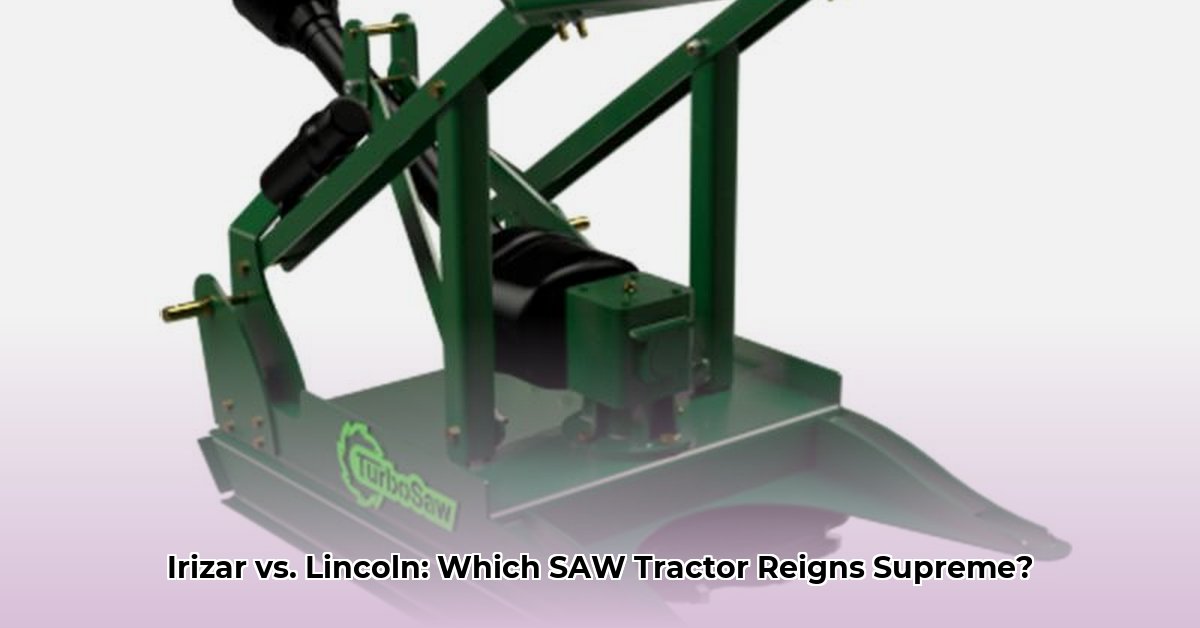
Selecting the optimal submerged arc welding (SAW) tractor demands careful consideration. This comparative review analyzes two prominent options: Irizar and the Lincoln Electric Cruiser®, highlighting their strengths and weaknesses to aid informed decision-making.
Welding Speed and Deposition Rate
The Lincoln Cruiser® boasts impressive welding speed, with user reports indicating deposition rates as high as 30 pounds per hour. This high output makes it ideal for large-scale projects requiring rapid completion. Conversely, the Irizar offers a more moderate welding speed, suitable for smaller to medium-sized projects. The optimal choice hinges on the scale of your typical projects. Which deposition rate aligns better with your project volume?
Power Source and Compatibility
The Irizar operates on a standard 110V power source, offering convenience but potentially limiting its use in locations with inconsistent power or on larger projects demanding higher amperage. The Lincoln Cruiser®, conversely, offers greater flexibility, readily accommodating higher voltage sources commonly found in industrial settings. Site power availability should be a critical factor in your selection. What power source consistently meets your project demands?
System Modularity and Customization
The Lincoln Cruiser®'s modular design provides significant customization advantages. Users can select tracked or wheeled movement, and choose between three or four-wheel configurations depending on terrain requirements. This adaptability proves invaluable for diverse job sites. The Irizar offers a less modular design; while this simplifies operation and maintenance, it lacks the versatility of the Cruiser®. Do you require a highly adaptable system or a simpler, more straightforward design?
Cost and Return on Investment (ROI)
Generally, the Irizar presents a lower initial investment compared to the Lincoln Cruiser®. This makes it an attractive option for businesses with budgetary constraints or those starting out. Moreover, its simpler design potentially translates to lower maintenance costs. The Cruiser®, however, initially demands a higher investment, yet often compensates through increased power and productivity, offering a potential for superior long-term ROI. What initial investment versus long-term productivity best suits your operational model?
Specialized Applications and Features
A key Irizar feature is its integrated magnetic device for vertical welding on tanks, particularly beneficial for companies specializing in tank construction or repair. The Lincoln Cruiser® doesn't explicitly advertise this feature. Assessing your project's specific needs is crucial. Which machine better adapts to your typical welding scenarios?
Comparative Feature Analysis
| Feature | Irizar SAW Tractor | Lincoln Cruiser® SAW Tractor |
|---|---|---|
| Deposition Rate | Moderate | High (up to 30 lbs/hour, user reported) |
| Power Source | 110V | Higher-voltage compatible |
| Modularity | Less modular | Highly modular (tracked/wheeled, 3/4 wheel options) |
| Initial Cost | Lower | Higher |
| Vertical Tank Welding | Included (magnetic device) | Not explicitly stated |
| Flux Recovery System | Typically Included; specific details vary by model | Available; level of sophistication varies by model |
Mitigating Potential Challenges
Even the best equipment presents potential challenges. Proactive measures can mitigate these risks:
| Feature | Irizar Potential Challenges | Lincoln Cruiser® Potential Challenges | Mitigation Strategies |
|---|---|---|---|
| Power Source | Insufficient power for large projects | Higher power consumption | Assess site power; consider backup generator. |
| Modularity | Limited adaptability to various conditions | Advanced features add to complexity & maintenance needs | Thorough planning, operator training, accessory selection. |
| Deposition Rate | Longer project timelines | High speed may necessitate increased operator skill | Task optimization, parameter setting, multiple units. |
| Flux Recovery System | System efficiency and maintenance vary. | System design and maintenance may require training. | Regular maintenance, operator training. |
Conclusion: Both the Irizar and Lincoln Cruiser® offer strengths. The optimal choice depends on individual project needs, budget, and typical welding tasks. Always adhere to relevant welding codes (e.g., ASME Section IX, AWS D1.1) and establish proper WPS and PQR. Careful pre-planning minimizes future complications.